Electrocardiography
Weill Cornell Medicine's state-of-the-art Coleman Center for Electrocardiography performs and provides professional interpretation of a range of inpatient and outpatient electrocardiographic procedures, including routine 12-lead electrocardiograms (ECGs), ambulatory (Holter) monitor recordings and exercise ECGs.
The Coleman Center for Electrocardiography is one of the busiest in the nation performing over 160,000 ECG interpretations a year. This includes over 1,000 exercise stress tests, and more than 1,000 ambulatory monitors.
Our team is led by academic cardiologists with extensive clinical and research experience in electrocardiography and includes cardiology fellows-in-training, all of whom rotate through our graphics and ECG lab as part of their training, and highly-experienced technicians. Our center provides a uniquely high-level of clinical service to NewYork-Presbyterian Hospital/Weill Cornell Medicine and the surrounding community.
What is Electrocardiography?
An electrocardiogram (ECG) is a diagnostic test that is used to detect abnormalities in the heart's rhythm, as well as to provide important information about damage to the electrical system of the heart, heart attacks, structural abnormalities in the heart's walls, and more.
Types of Electrocardiograms
Our center provides the full range of advanced electrocardiography services, including:
Resting 12-Lead ECG
This test monitors the heart's activity at rest and provides information about the heart’s rhythm, acute and prior heart attacks, and abnormalities of the structure and electrical system of the heart.
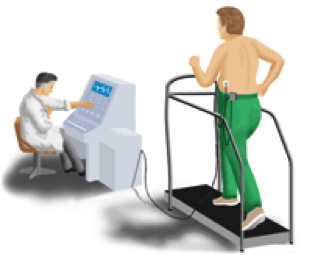
Stress Test (Exercise ECG) and Stress Echocardiogram
Stress tests monitor the heart's activity under conditions of physical exercise. It is used for the evaluation of exercise capacity, for the detection of coronary disease and the assessment of its severity, for prediction of cardiovascular risk, and for monitoring the response to treatment.
A stress echocardiogram can be performed to look for transient changes in the movement of one or more of the walls of the pumping chamber of the heart (the left ventricle) that can provide additional diagnostic information regarding the presence of narrowing in the arteries that supply blood flow to the heart muscle, which can suggest coronary artery disease (CAD). There are several other reasons to perform a stress echocardiogram, including heart conditions such as hypertrophic cardiomyopathy and valvular heart disease.
During a stress echocardiogram, ultrasound imaging is performed both before and after your heart is stressed. Exercise is a common method of stress for this procedure. For people who cannot exercise, medication-based stress testing can be performed. For example, dobutamine is a medication that is administered through a peripheral IV; it increases the heart rate like during exercise.
Holter (Ambulatory) Monitoring
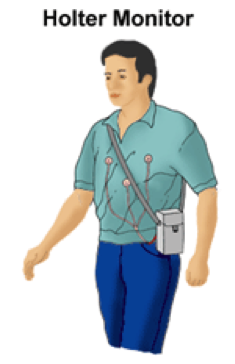
The Holter monitor is a portable electrocardiograph machine that allows readings to be made over a 24-hour period, while the individual is performing the usual activities of daily living at home or at work. This test is useful for detection of intermittent rhythm abnormalities of the heart, to quantify certain abnormalities and to relate patient symptoms to possible rhythm abnormalities.
Request an Appointment
Often, imaging studies and cardiac testing will require a referral from your physician and, in some cases, pre-authorization from your insurance company. Our patient coordinators are skilled in this process and will assist you every step of the way. To request an appointment with electrocardiography please call (212) 746-4670.
Our Physicians
| Faculty | Title | Phone | ||
|---|---|---|---|---|
 |
Sandeep Gangireddy, M.D. |
Assistant Professor of Clinical Medicine | 646-962-5558 | Full Profile |
 |
Edwin Homan, M.D. Ph.D. |
Assistant Professor of Medicine | 646-962-5558 | Full Profile |
 |
Samuel M. Kim, M.D. |
Assistant Professor of Medicine, Director Preventive Cardiology | 646-962-5558 | Full Profile |
 |
Arielle Kushman, M.D. |
Assistant Professor of Medicine | 646-962-5558 | Full Profile |
 |
Julie Marcus, M.D. |
Assistant Professor of Clinical Medicine | 646-962-5558 | Full Profile |
 |
Peter M. Okin, M.D. |
Professor of Medicine, Director Cardiac Graphics | 646-962-5310 | Full Profile |