

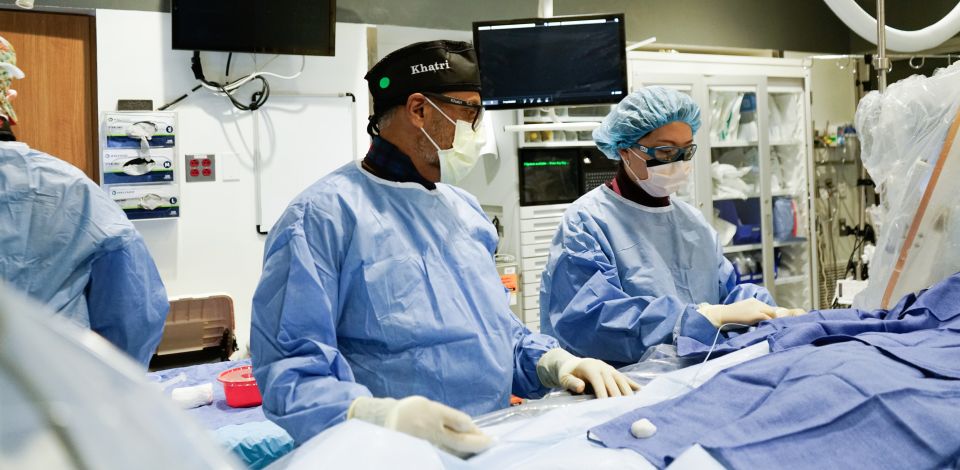
Interventional Cardiology and Cardiac Catheterization
Interventional cardiology is the specialty of diagnosing and treating heart and blood vessel conditions using non-surgical, minimally invasive cardiac catheterization techniques.
The Cardiac Catheterization Laboratory of NewYork-Presbyterian Hospital/Weill Cornell Medical Center is at the cutting edge of interventional cardiology.
Our highly trained interventional cardiologists specialize in catheter-based methods to treat coronary artery disease, peripheral vascular disease, structural heart disease, and adult congenital heart conditions. These highly efficient techniques allow patients to avoid open-heart surgery. Compared with surgery, interventional procedures can be performed through much smaller openings with consequently lower blood loss, faster recovery time and shorter hospital stays.
What is Cardiac Catheterization?
Cardiac catheterization is a minimally invasive procedure used to detect the presence of heart disease. During this procedure a catheter (long, thin tube) is inserted into the groin or wrist through a small puncture (cut) and advanced to the heart. Dye is injected to identify any blockages in the heart. This is referred to as an angiogram. If a blockage is detected, it can be opened through an angioplasty or stent implantation. In addition, pressure in the heart chambers is measured to check cardiac pump and heart valve function. Cardiac catheterization is a highly efficient technique that minimizes pain and speeds recovery.
Our Services
Our team of renowned interventional cardiologists offers treatments and procedures for:
Coronary Artery Disease (CAD)
Treatment of narrowed heart arteries using drug-coated balloon angioplasty, stent placement, atherectomy, and thrombectomy. These procedures are made more accurate and durable using additional tools such as OCT, IVUS, and FFR. In addition, there is a team dedicated to the treatment of chronic total occlusions (CTO) which are completely blocked coronary arteries.
Coronary intervention can be lifesaving in a heart attack and can alleviate chest pain and shortness of breath that is not responding to medical treatment. In very complex cases, patients can be supported using temporary mechanical circulatory support (MCS) to allow the doctor to safely complete the procedure.
Heart Valve Replacement or Repair
Transcatheter aortic valve replacement (TAVR), balloon valvuloplasty, minimally invasive repair or replacement of the mitral and tricuspid valves.
Peripheral Artery Disease (PAD)
Balloon angioplasty, stent placement, and atherectomy of leg and arm arteries.
Renal Denervation
Minimally invasive modification of the nerves in the kidney arteries to treat elevated blood pressure that is not responding to medical therapy.
Carotid Stenting
Treatment of blockages in the neck arteries supplying the brain to treat and prevent stroke.
Abdominal Aortic Aneurysm Repair
Minimally invasive repair using specialized stent “grafts” to prevent further enlargement of the aneurysm.
Atrial Septal Defect and Patent Foramen Ovale
Non-surgical closure of holes in the heart that can cause shortness of breath and increase risk of stroke.
Angina with Non-Obstructive Coronary Arteries (ANOCA)
Chest pain without narrowing of the large heart arteries can be due to poorly functioning “micro-circulation.” This can be diagnosed using specialized instruments during a cardiac catheterization to offer more tailored treatment.
Schedule an Appointment
To schedule an appointment to see one of our physicians with expertise in interventional cardiology, please call (646) 962-5500.
If you are already an established patient, you may also request an appointment online using Weill Cornell CONNECT. We will make every effort to contact you within 24 hours.
Our staff is here to help coordinate your care. They will provide you with information on our physicians, their areas of expertise and help arrange your visit and other testing when appropriate. If you are scheduled for a procedure, you may be treated by multiple doctors on our team who frequently collaborate to provide the best possible care.
For more information visit: Guide to Cardiac Catheterization, Angioplasty, and Stent Implantation.
Information for Referring Physicians
To schedule Catheterization Lab Procedures:
Phone: (212) 746-4644
Fax: (212) 746-8295
Email: nypcornellcath@nyp.org
If you are a referring physician and wish to schedule your patient for a cardiac catheterization admission, please complete the CATH Lab Intake Form and fax to (212) 746-8295.
You may also contact our intake office directly by calling (212) 746-4644 and speaking to one of our intake staff for more information or assistance.
Our Physicians
| Faculty | Title | Phone | ||
|---|---|---|---|---|
 |
Geoffrey W. Bergman, M.B.,B.S. |
Associate Professor of Medicine | 646-962-5500 | Full Profile |
 |
Shmuel Chen, M.D., Ph.D. |
Assistant Professor of Medicine | 646-962-5500 | Full Profile |
 |
Dmitriy N. Feldman, M.D. |
Professor of Medicine, Director Endovascular Services | 646-962-5500 | Full Profile |
 |
Jaya Kanduri, M.D. |
Assistant Professor of Medicine | 646-962-5558 | Full Profile |
 |
Jaikirshan Khatri, M.D. |
Associate Professor of Medicine (Pending Appointment at Rank) , Director, Cardiac Catheterization Laboratories | 646-962-5500 | Full Profile |
 |
Luke Kim, M.D. |
Professor of Medicine, Director Interventional Cardiology Fellowship | 646-962-5500 | Full Profile |
 |
Mahesh V Madhavan, MD, MS |
Assistant Professor of Clinical Medicine | 646-962-5500 | Full Profile |
 |
Robert Mark Minutello, M.D. |
Associate Professor of Clinical Medicine, Director, NYPQ Cardiac Catheterization Laboratory and Structural Heart Disease | 646-962-5500 | Full Profile |
 |
Harsimran Sachdeva Singh, M.D. |
Assistant Professor of Medicine, Director Adult Congenital Heart Disease, Director Cardiovascular Disease Fellowship | 646-962-2243 | Full Profile |